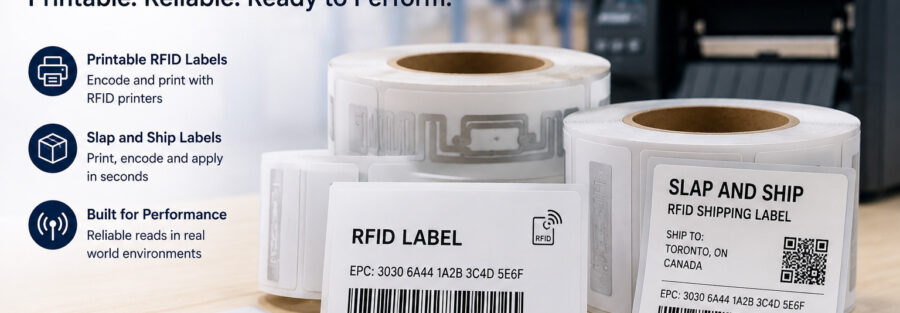
Most people think of an RFID label as simply a sticker with a chip inside.
While that’s technically true, modern RFID labels have evolved into highly engineered products designed for specific environments, materials, read ranges, and business processes. Selecting the wrong RFID label can reduce read accuracy, shorten product life, and negatively impact an RFID deployment before it even begins.
Whether you’re tracking inventory in a warehouse, shipping pallets across Canada, or managing returnable assets, understanding the different types of RFID labels is one of the most important decisions in an RFID project.
What Is an RFID Label?
An RFID label combines three technologies into a single product:
• A printable label surface
• An RFID inlay containing a microchip and antenna
• An adhesive designed for the intended application
Unlike traditional barcode labels, RFID labels can be identified wirelessly without requiring direct line of sight. Hundreds of labels can be read simultaneously, allowing organizations to automate inventory counts, shipping verification, and asset identification.
Most enterprise deployments today use passive UHF RFID labels, which are powered by the energy transmitted from an RFID reader. Because they contain no battery, passive labels are inexpensive, lightweight, and can last for many years.
Printable RFID Labels
Printable RFID labels are the most common type used in manufacturing, logistics, retail, healthcare, and distribution centers.
These labels are designed to work with RFID printers from manufacturers such as Zebra, allowing organizations to print human readable text, barcodes, QR codes, and encode the RFID chip in a single operation.
Typical information printed includes:
• Product descriptions
• Serial numbers
• Asset numbers
• EPC codes
• QR codes
• Shipping information
This allows one label to serve both traditional barcode workflows and RFID enabled automation, making migration significantly easier for organizations transitioning from barcode systems.
What Are Slap and Ship RFID Labels?
One of the fastest growing applications is the use of slap and ship RFID labels.
Instead of applying permanent RFID labels during manufacturing, organizations print and encode RFID shipping labels only when products are ready for dispatch.
The process is simple.
An RFID printer produces the shipping label.
The RFID chip is automatically encoded.
The label is applied to the carton or pallet.
The shipment immediately becomes RFID enabled.
This approach is particularly useful for retailers, third party logistics providers, suppliers shipping into major distribution networks, and organizations meeting RFID compliance requirements.
Because RFID is added at the shipping stage, companies avoid permanently tagging products that may never require RFID throughout their lifecycle.
Choosing the Right RFID Label
Not all RFID labels perform the same.
Selection depends on several factors including:
• Surface material
• Read distance
• Environmental conditions
• Reader infrastructure
• Printer compatibility
• Industry standards
For example, labels designed for corrugated cartons perform differently from labels attached to plastic containers or metal equipment. Specialized on metal RFID labels include additional material layers that improve read performance on conductive surfaces.
Environmental factors such as moisture, temperature, chemicals, and UV exposure should also be considered when selecting adhesives and label materials.
Looking Beyond the Label
An RFID label is only one component of an RFID solution.
Successful deployments combine the right label with properly selected RFID readers, printers, software, and integration into enterprise platforms such as Microsoft Dynamics 365, SAP, Oracle, or warehouse management systems.
The objective isn’t simply identifying products. It’s creating accurate, automated data that supports better operational decisions.
Final Thoughts
RFID labels continue to evolve as organizations seek greater visibility across manufacturing, logistics, retail, healthcare, and supply chain operations. From printable RFID labels used every day in warehouses to slap and ship labels supporting modern distribution networks, the technology provides a practical path toward faster identification, improved inventory accuracy, and more efficient shipping operations.
If you’re evaluating RFID labels, RFID printers, or slap and ship solutions, selecting the correct label is often the first step toward a successful RFID deployment.