Types of RFID Asset Tags for Equipment and IT Assets
Organizations across Canada rely on physical assets to support daily operations. From laptops and mobile devices to industrial equipment and specialized tools, these assets represent a significant financial investment. Maintaining visibility over these assets is essential for operational efficiency, compliance, and accurate financial reporting.
However, managing asset inventories manually can be extremely difficult. Many organizations still rely on spreadsheets, manual audits, or barcode scanning systems to track equipment across facilities. As asset inventories grow larger, these methods become inefficient and prone to errors.
RFID technology provides a more automated solution. By attaching RFID asset tags to equipment and integrating RFID readers with asset management systems, organizations can automatically identify and track assets across multiple locations.
RFID asset tags play a critical role in these systems. These small devices allow assets to be uniquely identified using radio frequency signals, enabling organizations to automate asset tracking processes and maintain accurate asset inventories.
Enterprises implementing RFID asset management systems are able to identify assets automatically and maintain accurate asset records across facilities.
What Are RFID Asset Tags
RFID asset tags are small electronic devices attached to physical assets to enable automatic identification using radio frequency technology.
Each RFID tag contains two primary components: a microchip and an antenna. The microchip stores a unique identifier associated with the asset record in the asset management database, while the antenna allows the tag to communicate with RFID readers.
When an RFID reader scans an area, it emits a radio signal that activates nearby tags. The tags respond by transmitting their unique identifier back to the reader.
This allows multiple assets to be detected simultaneously.
Unlike barcode systems, RFID tags do not require direct line-of-sight scanning. RFID readers can detect tags even if they are inside cabinets, boxes, or storage rooms.
This capability allows organizations to perform asset audits quickly and accurately.
Many companies deploy RFID asset tracking systems to automate equipment audits and improve asset visibility across facilities.
Why RFID Asset Tags Are Important for Asset Management
Accurate asset identification is the foundation of effective asset management. Without reliable identification methods, organizations struggle to maintain accurate asset records.
RFID asset tags provide a reliable way to identify assets automatically. Each tag contains a unique identifier that corresponds to the asset record in the asset management system.
When RFID readers detect the tag, the system instantly identifies the asset.
This automation allows organizations to track thousands of assets across large facilities without relying on manual scanning processes.
Advisory firms such as PwC and Deloitte frequently highlight the importance of reliable operational data in enterprise decision making. Without accurate asset visibility, organizations may struggle to manage equipment inventories effectively.
RFID asset tagging enables enterprises to create automated RFID asset management solutions that provide real time visibility into asset inventories.
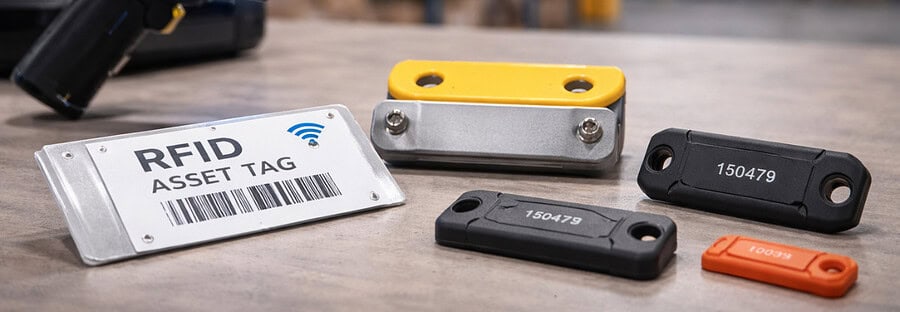
Common Types of RFID Asset Tags
Different asset types and environments require different RFID tag designs. Selecting the correct tag type is essential for reliable performance.
RFID Label Tags
RFID label tags are thin adhesive labels commonly used for IT assets such as laptops, tablets, and office equipment.
These tags are lightweight and inexpensive, making them suitable for large scale deployments.
Rugged RFID Tags
Industrial environments often require rugged RFID tags designed to withstand harsh conditions such as vibration, moisture, and dust.
These tags are commonly used to track tools, machinery, and operational equipment in manufacturing facilities.
Metal Mount RFID Tags
Tracking metal assets presents unique challenges because metal surfaces can interfere with radio signals.
Metal mount RFID tags are designed specifically for use on metal equipment, allowing organizations to track machinery and infrastructure reliably.
High Temperature RFID Tags
Manufacturing environments sometimes require RFID tags that can withstand high temperatures during production processes.
These tags are designed for specialized applications where standard RFID tags may not perform reliably.
Selecting the appropriate RFID asset tags ensures reliable asset tracking performance across different environments.
Passive vs Active RFID Asset Tags
RFID asset tags are generally classified into two categories: passive tags and active tags.
Passive RFID Tags
Passive RFID tags do not contain a battery. Instead, they are powered by the radio signal emitted by the RFID reader.
These tags are smaller, less expensive, and widely used for asset tracking applications.
Most enterprise asset management systems rely on passive RFID asset tags.
Active RFID Tags
Active RFID tags contain an internal battery that allows them to transmit signals over longer distances.
These tags are typically used for specialized applications such as real time location tracking.
While active tags offer extended range, they are generally more expensive and require battery maintenance.
Organizations deploying enterprise asset tracking solutions often rely primarily on passive RFID asset tags.
How RFID Asset Tags Enable Automated Asset Tracking
RFID asset tags form the foundation of automated asset tracking systems.
The process begins when an asset is registered in the asset management database. A unique identifier is assigned to the asset and encoded onto the RFID tag.
The tag is then attached to the asset.
When RFID readers scan the environment, they detect nearby tags and capture their identifiers.
The asset management software processes this information and updates asset records automatically.
This process allows organizations to maintain accurate asset inventories without relying on manual scanning.
Many enterprises integrate RFID readers with RFID asset management platforms that provide centralized visibility into asset inventories across facilities.
Industries Using RFID Asset Tags
RFID asset tags are widely used across industries where asset visibility is critical.
Healthcare organizations use RFID asset tags to track medical equipment and ensure that devices are available when needed.
Manufacturing companies use RFID asset tagging to track tools, machinery, and production equipment across large facilities.
Logistics companies use RFID tags to track transportation equipment and operational infrastructure.
Universities and research institutions use RFID asset tags to manage laboratory equipment and IT infrastructure across campuses.
As organizations pursue digital transformation initiatives, RFID asset tags are becoming an increasingly important component of modern asset management systems.
Benefits of RFID Asset Tags
Organizations implementing RFID asset tagging often experience several operational benefits.
One of the most important benefits is improved asset visibility. RFID readers allow organizations to identify assets quickly and maintain accurate inventory records.
RFID asset tagging also reduces the time required to perform asset audits.
Instead of manually scanning each asset, RFID readers can detect many tagged assets simultaneously.
Inventory accuracy also improves significantly because asset identification is automated.
RFID asset tags also help reduce asset losses by making it easier to detect missing equipment.
These advantages make RFID asset tagging an attractive solution for organizations seeking to modernize asset management processes.
Choosing the Right RFID Asset Tags
Selecting the correct RFID asset tags depends on several factors.
Organizations should consider the type of assets being tracked, the environment where the assets operate, and the scanning range required.
Testing different tag types during pilot deployments can help determine which tags perform best in specific environments.
Organizations planning large scale RFID deployments often work with specialists to ensure that tag selection and reader configuration are optimized for their operational environment.
By selecting the correct RFID asset tags and integrating them with enterprise systems, organizations can build reliable RFID asset management systems that improve asset visibility and operational efficiency.
The Future of RFID Asset Tagging
As enterprises continue to digitize operations, technologies that connect physical assets with digital systems will become increasingly important.
RFID asset tags provide the foundation for automated asset tracking systems that generate reliable operational data.
Enterprises across Canada are increasingly adopting RFID asset management solutions to improve asset visibility and streamline operational processes.
As RFID technology continues to evolve, asset tagging systems will play an increasingly important role in helping organizations manage their physical infrastructure more effectively.