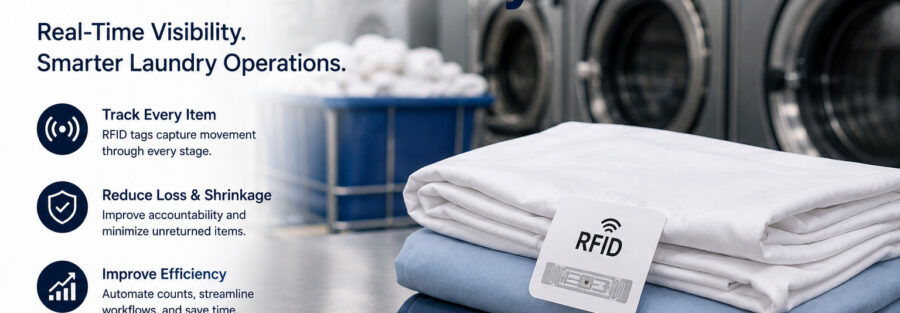
Understanding the Laundry Workflow
Laundry operations involve multiple stages where linen moves continuously across departments, facilities, and processing areas. In Canada, organizations across healthcare, hospitality, and industrial sectors face the same challenge: high volume movement with limited visibility.
From collection to redistribution, linen passes through several touchpoints. Without a connected system, each stage operates independently, making it difficult to maintain accuracy and control.
Where RFID Fits in the Process
RFID integrates into existing laundry workflows without adding complexity. Instead of changing operations, it connects them.
Each linen item is tagged once and then identified automatically at key checkpoints.
Step 1: Collection at Source
At the point of use, linen is collected from wards, rooms, or work areas. Instead of manual counting, items can be scanned in bulk.
- Linen is already tagged and ready for identification
- Bags or carts are scanned without opening or handling items individually
- Counts are captured instantly and accurately This ensures that what leaves the department is properly recorded.
Step 2: Transport and Movement
As linen moves between departments or facilities, RFID continues to capture movement without requiring manual intervention.
- No need for individual scans during transit
- Movement can be validated at entry and exit points
- Responsibility is clearly defined at each handoff Visibility is maintained even when items are moving in bulk.
Step 3: Laundry Intake
At the laundry facility, intake is one of the most critical checkpoints.
- Bulk scanning validates incoming quantities
- Discrepancies are identified immediately
- Soiled and contaminated flows can be verified Instead of assumptions, intake becomes a controlled process.
Step 4: Washing and Processing
During washing and drying, no scanning is required. RFID tags are designed to withstand high temperatures and harsh conditions.
- Each wash cycle can be recorded automatically
- Linen lifecycle data begins to build over time
- No disruption to existing laundry processes The system works in the background without adding operational steps.
Step 5: Sorting and Packing
After processing, linen is sorted and prepared for redistribution.
- Bulk verification ensures correct quantities
- Orders or department allocations can be validated instantly
- Errors are caught before dispatch This reduces downstream issues and rework.
Step 6: Redistribution to Departments
Clean linen is returned to departments with full visibility.
- Receiving teams can verify counts quickly
- Inventory levels become accurate across locations
- Usage patterns begin to emerge over time Departments no longer rely on estimates or buffers.
What Changes in Daily Operations
Once RFID is implemented, the workflow remains the same, but the level of control changes significantly.
- Manual counting is eliminated
- Disputes between departments are reduced
- Inventory becomes accurate and reliable
- Staff spend less time verifying and more time operating The process does not become more complex. It becomes more connected.
What Data You Start Seeing
RFID introduces data that was previously unavailable in traditional laundry systems.
- Actual inventory levels at each checkpoint
- Turnaround time from collection to reuse
- Loss points across departments or facilities
- Usage trends by location or category This data supports better decision making across the organization.
Where Implementations Go Wrong
The technology itself is straightforward, but success depends on how it is applied.
- Focusing only on tags instead of process design
- Not defining clear scanning checkpoints
- Ignoring operational workflows during implementation RFID works best when aligned with real operational processes, not layered on top of them.
Why This Matters in Canada
Organizations in Canada are dealing with increasing operational pressure, rising costs, and higher expectations around accountability. Laundry operations are no longer just a support function. They are a measurable part of operational performance.
The Takeaway
RFID in laundry management is not about tracking individual items for the sake of it. It is about connecting each stage of the process into a single, visible system.
Companies like 44North Tech are helping organizations across Canada implement RFID in a way that aligns with operations, delivering accuracy, efficiency, and control without adding complexity.