Which Is Better for Enterprises?
Organizations across Canada rely on asset tracking systems to maintain visibility over equipment, infrastructure, and operational tools. From IT devices to industrial machinery, accurate asset tracking is essential for operational efficiency, compliance, and financial accountability.
For many years, barcode systems have been the most common method used to track assets. However, as organizations grow and asset inventories expand, barcode systems often become inefficient and difficult to manage.
RFID asset tracking has emerged as a powerful alternative that allows organizations to identify assets automatically using radio frequency technology. By attaching RFID asset tags to equipment and using RFID readers to detect them, enterprises can automate asset tracking processes and significantly improve operational visibility.
Understanding the differences between barcode asset tracking and RFID asset tracking is essential for organizations considering modern asset management technologies.
Enterprises evaluating new asset tracking technologies often explore RFID asset management systems that combine RFID asset tagging with enterprise asset databases.
What Is Barcode Asset Tracking?
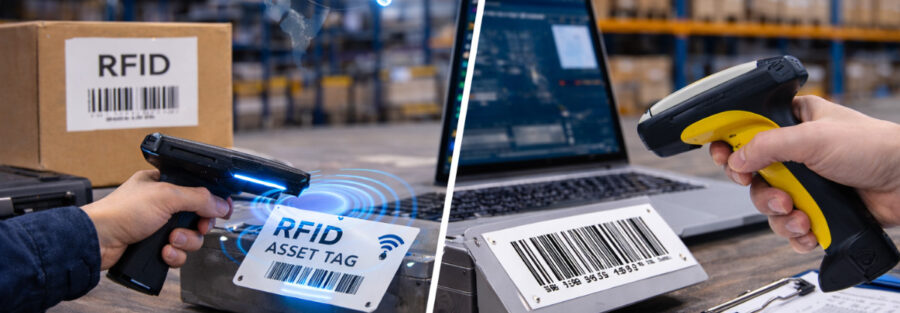
Barcode asset tracking is a system that uses printed barcodes attached to assets. Each barcode represents a unique identifier that corresponds to a record in the asset management system.
When an employee scans the barcode using a handheld scanner, the system retrieves the asset record and updates its status or location.
Barcode tracking systems are widely used because they are relatively inexpensive and simple to deploy. Many organizations already use barcode technology for inventory management, making it a familiar solution.
However, barcode tracking systems have several limitations when used for large asset inventories.
Each asset must be scanned individually, which requires employees to physically locate every item during audits. This process becomes extremely time consuming when organizations manage thousands of assets across multiple locations.
What Is RFID Asset Tracking?
RFID asset tracking uses radio frequency identification technology to automatically detect assets that have RFID tags attached.
Each RFID asset tag contains a small microchip and antenna that store a unique identifier. RFID readers emit radio signals that activate nearby tags and capture their identifiers automatically.
Unlike barcode systems, RFID does not require line-of-sight scanning. RFID readers can identify many assets simultaneously, even if they are inside cabinets, boxes, or storage rooms.
This allows organizations to scan entire rooms or storage areas in seconds rather than scanning each asset individually.
Companies implementing RFID asset tracking systems often achieve dramatically faster asset audits and improved inventory accuracy.
These systems are frequently integrated into broader RFID asset management platforms that automate asset visibility across facilities.
Key Differences Between RFID and Barcode Tracking
While both technologies are used to track assets, they operate very differently.
Scanning Method
Barcode scanning requires direct line-of-sight scanning. The barcode must be visible to the scanner.
RFID scanning does not require line-of-sight. RFID readers can detect tags automatically within their scanning range.
Number of Assets Scanned
Barcode systems scan one asset at a time.
RFID readers can detect hundreds of assets simultaneously.
Speed of Asset Audits
Barcode audits can take days or weeks when asset inventories are large.
RFID asset tracking allows organizations to complete audits dramatically faster.
Automation
Barcode systems rely heavily on manual scanning.
RFID systems automate asset identification and data collection.
Asset Visibility
Barcode systems only provide visibility when assets are scanned manually.
RFID systems allow organizations to detect assets automatically when they enter scanning zones.
Why Many Enterprises Are Moving to RFID
As organizations grow, asset inventories become more complex. Managing thousands of assets manually becomes increasingly inefficient.
Large advisory firms such as Deloitte and PwC have frequently emphasized the importance of reliable operational data for enterprise decision making.
Without accurate asset visibility, organizations may struggle with:
misplaced equipment
duplicate purchases
inaccurate asset records
inefficient asset utilization
RFID asset tracking addresses these challenges by automating the identification of physical assets.
Organizations adopting RFID asset management solutions gain improved visibility into asset location, status, and usage across facilities.
Asset Audit Efficiency
One of the most significant advantages of RFID asset tracking is the improvement in asset audit efficiency.
In a barcode system, employees must locate each asset and scan it individually. In large organizations, this process may require weeks of manual effort.
With RFID asset tagging, employees can scan entire rooms or storage areas within seconds. RFID readers automatically identify all nearby assets.
This allows organizations to perform asset audits far more quickly while improving accuracy.
Companies implementing RFID asset tracking often report dramatic reductions in audit time.
Asset Visibility Across Facilities
Large organizations often manage assets across multiple buildings or operational sites. Maintaining accurate visibility across these locations can be difficult.
Barcode systems require manual scanning to update asset records, which means asset movements may go unrecorded.
RFID asset tracking systems can automatically detect assets as they move through facilities, allowing organizations to maintain more accurate asset records.
Many enterprises integrate RFID technology into centralized RFID asset management systems that provide visibility across entire operations.
When Barcode Tracking Still Makes Sense
Despite its limitations, barcode tracking still has some advantages in certain situations.
Barcode systems are inexpensive to deploy and require minimal infrastructure.
Small organizations with limited asset inventories may find barcode tracking sufficient for their needs.
However, as asset inventories grow larger and operational complexity increases, many organizations find that barcode systems no longer provide sufficient efficiency.
In these cases, RFID asset tagging offers a more scalable solution.
Industries Using RFID Asset Tracking
RFID asset tracking is widely used across industries where asset visibility is critical.
Healthcare organizations use RFID to track medical equipment and ensure devices are available when needed.
Manufacturing companies use RFID asset tagging to track tools, machinery, and production equipment across large facilities.
Transportation and logistics companies deploy RFID asset tracking to monitor operational equipment and improve asset utilization.
Universities and research institutions also use RFID asset tagging to manage laboratory equipment and technology assets.
As organizations pursue digital transformation initiatives, RFID asset tracking is becoming an increasingly important technology for enterprise asset management.
The Future of Enterprise Asset Tracking
As businesses continue to digitize operations, maintaining accurate asset visibility will become even more important.
RFID technology allows organizations to connect physical assets with digital systems, enabling better operational decision making.
Enterprises across Canada are increasingly adopting RFID asset management platforms to improve asset visibility and automate asset tracking processes.
By combining RFID asset tagging with enterprise software platforms, organizations can create automated asset tracking systems that improve efficiency and reduce operational risk.
RFID asset tracking is therefore becoming a foundational technology for modern enterprise asset management strategies.
Conclusion
Barcode asset tracking systems have served organizations for many years, but they are often limited by manual processes and inefficient asset audits.
RFID asset tracking provides a more automated and scalable solution for managing large asset inventories.
By enabling organizations to identify assets automatically and maintain real time visibility, RFID technology significantly improves asset management capabilities.
As enterprises continue to modernize operations, RFID asset tagging and asset tracking technologies are likely to play an increasingly important role in helping organizations maintain accurate asset inventories and improve operational efficiency.