A Complete Guide for Enterprises in Canada
Organizations across Canada are under increasing pressure to maintain accurate visibility of their physical assets. Equipment, IT infrastructure, tools, and operational devices represent millions of dollars in capital investment. Yet many organizations still rely on spreadsheets, manual audits, or outdated barcode systems to track these assets.
This lack of asset visibility creates operational inefficiencies and financial risk. When organizations cannot accurately identify where assets are located, how they are being used, or whether they are still in service, decision making becomes difficult.
RFID asset management provides a modern solution to this challenge. By combining RFID asset tags, wireless scanning technology, and enterprise asset databases, organizations can automatically identify and manage thousands of assets across multiple facilities.
RFID asset management systems allow businesses to digitize the physical world. Each asset is assigned a unique RFID tag that can be scanned automatically by RFID readers. The system records the identity, location, and status of assets in real time.
This automation significantly improves asset visibility and reduces the manual effort required to manage equipment inventories.
Many organizations implementing RFID asset management systems are able to complete asset audits dramatically faster while improving inventory accuracy and operational accountability. Learn more about how these systems work in our overview of RFID asset management systems.
Why Asset Visibility Is a Growing Challenge
Enterprise organizations often manage thousands of physical assets across offices, warehouses, hospitals, manufacturing facilities, and operational sites. Maintaining an accurate inventory of these assets becomes increasingly complex as organizations grow.
Traditional asset tracking processes typically involve manual record keeping and barcode scanning. Employees must physically locate each asset, verify its identity, and update asset records manually.
These processes are time consuming and often produce inaccurate results. Assets may be misplaced, transferred between departments without documentation, or recorded incorrectly in inventory systems.
Large consulting and advisory firms such as PwC, Deloitte, and KPMG frequently highlight the importance of accurate asset visibility for operational planning and financial reporting. Organizations that lack reliable asset data often face compliance challenges, operational inefficiencies, and unnecessary capital expenditures.
For example, companies sometimes purchase new equipment simply because existing assets cannot be located quickly. Without reliable asset tracking, organizations lose visibility into how equipment is being used and whether it is still operational.
RFID asset tracking technologies address this challenge by automating the identification of physical assets.
How RFID Asset Tracking Works
RFID asset tracking uses radio frequency technology to automatically identify tagged assets within a facility.
Each asset is assigned a small RFID tag that contains a microchip and antenna. This RFID asset tag stores a unique identifier associated with the asset record in the asset management database.
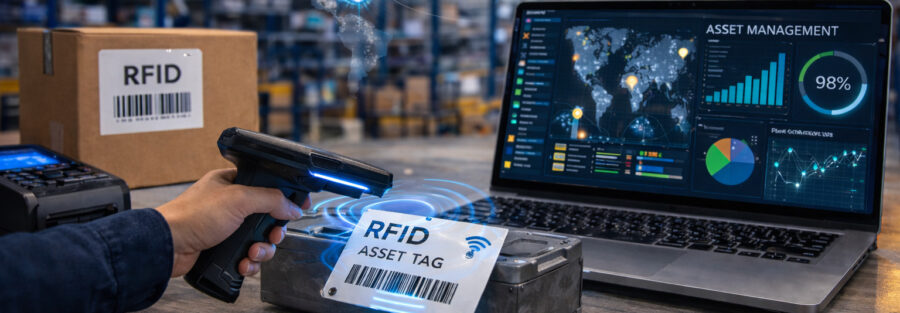
When an RFID reader scans an area, it emits a radio signal that activates nearby RFID tags. The tags respond by transmitting their unique identifier back to the reader.
The reader then sends this information to the asset management system, which updates the asset record in real time.
Unlike barcode systems, RFID asset tracking does not require direct line of sight scanning. RFID readers can identify hundreds of assets simultaneously, allowing organizations to perform asset audits much faster.
This capability makes RFID asset tracking particularly valuable in environments where large numbers of assets must be managed across multiple locations.
Organizations that deploy RFID asset tracking solutions often reduce the time required for asset audits from weeks to hours.
Components of an RFID Asset Management System
A typical RFID asset management system includes several core components that work together to automate asset identification and tracking.
RFID Asset Tags
RFID asset tags are attached to physical assets such as laptops, tools, medical equipment, or industrial machinery. Each tag contains a microchip and antenna that store a unique identifier for the asset.
RFID Readers
RFID readers detect nearby tags and capture their unique identifiers. These readers can be handheld devices used during audits or fixed readers installed in strategic locations.
Asset Management Software
Asset management software processes RFID scan data and maintains a digital inventory of all tagged assets. The system records asset location, movement, and status.
Enterprise System Integration
Many organizations integrate RFID asset management systems with enterprise platforms such as ERP systems, asset management databases, or IT asset management platforms. This integration ensures that asset records remain synchronized across operational systems.
Together these components create a powerful RFID asset tracking ecosystem that enables organizations to maintain accurate asset inventories with minimal manual effort.
Types of RFID Asset Tags
Selecting the correct RFID asset tags is essential for successful RFID deployments. Different asset types and environments require different tag designs.
RFID Label Tags
RFID label tags are thin adhesive tags commonly used for office equipment and IT assets such as laptops and tablets. These tags are cost effective and easy to deploy.
Rugged RFID Tags
Industrial environments often require rugged RFID tags designed to withstand harsh conditions such as vibration, moisture, and extreme temperatures.
Metal Mount RFID Tags
Tracking metal assets presents unique challenges because metal surfaces can interfere with radio signals. Metal mount RFID tags are designed specifically to operate reliably when attached to metallic equipment.
High Temperature RFID Tags
Manufacturing and industrial processes sometimes require tags capable of operating in high temperature environments.
Choosing the correct RFID asset tags ensures reliable asset tracking performance and long term durability.
Organizations designing RFID solutions often incorporate these tags as part of a broader RFID asset tagging strategy.
RFID Asset Tracking vs Barcode Tracking
Barcode asset tracking systems have been widely used for many years and remain common in many organizations. However, barcode systems have several limitations that make them less suitable for large scale asset management.
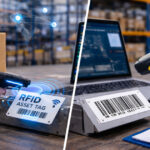
Barcode systems require direct line of sight scanning. Each asset must be physically located and scanned individually using a handheld device.
In environments with thousands of assets, this process becomes extremely time consuming.
RFID asset tracking eliminates this limitation. RFID readers can identify multiple assets simultaneously without requiring direct line of sight.
This capability allows organizations to scan entire rooms or storage areas within seconds.
As asset inventories grow larger and operational complexity increases, RFID asset tracking provides a more scalable approach to asset management.
Many organizations are therefore transitioning from barcode systems to integrated RFID asset management solutions that provide greater automation and visibility.
Industries Adopting RFID Asset Management
RFID asset management is being adopted across a wide range of industries where asset visibility is critical.
Healthcare organizations use RFID asset tagging to track medical equipment such as infusion pumps, diagnostic devices, and mobile workstations.
Manufacturing companies deploy RFID asset tracking to monitor tools, machinery, and production equipment across large facilities.
Logistics and transportation companies use RFID to track operational assets and improve equipment utilization.
Universities and research institutions use RFID systems to manage laboratory equipment and technology assets across campuses.
As organizations pursue digital transformation initiatives, asset visibility technologies such as RFID are becoming increasingly important.
Industry analysts and publications such as Forbes frequently highlight how automation technologies are transforming operational management across industries.
Benefits of RFID Asset Management
Organizations deploying RFID asset management systems often experience significant operational improvements.
One of the most immediate benefits is improved asset visibility. Organizations can instantly identify which assets are present in a location and which assets are missing.
RFID also reduces the time required to perform asset audits. Instead of manually scanning each asset, RFID readers can capture large asset inventories within minutes.
Inventory accuracy also improves significantly. Automated identification reduces the likelihood of human error in asset records.
RFID systems also improve compliance reporting. Many industries require organizations to maintain accurate records of equipment and infrastructure assets. RFID asset tracking helps ensure that these records remain accurate and up to date.
Finally, RFID asset management systems can reduce asset losses by making it easier to locate equipment quickly.
The Future of Enterprise Asset Visibility
As organizations continue to digitize operations, the importance of accurate asset data will continue to grow.
Enterprise decision making increasingly depends on reliable operational data. However, many organizations still lack visibility into the physical assets that support their operations.
RFID asset management bridges this gap by connecting physical assets with digital information systems.
By automatically identifying and tracking assets, organizations can generate reliable operational data that supports planning, compliance, and efficiency.
Across Canada, enterprises are increasingly adopting RFID asset management solutions to improve asset visibility and operational decision making.
As RFID technology continues to evolve, it is likely to play an even greater role in helping organizations manage their physical infrastructure more effectively.